Showing posts with label book review. Show all posts

Saturday, April 9, 2011

Morning Glories - Nick Spencer

I have to admit, when I first heard about "Morning Glories" I was a little bit less than enthusiastic about reading it.  Reading a comic about six gifted kids at a prestigious prep school seemed about as appealing as a trip to the dentist.  I spent four years in high school, and believe me, I'm not in any rush to go back.  Unfortunately, every trip to my comic store had me passing "Morning Glories" on the shelf, trying to avoid eye contact.  It didn't help that everyone I talked to told me I needed to be reading it.  I was starting to have flashbacks to 1997 when "Titanic" came out and peer pressure led to one of the bigger mistakes of my twenty-nine years.  Was I really about to read something made for teenage girls, just because everyone said it was good? 

As I've already mentioned, "Morning Glories" takes place inside a prestigious prep school for gifted teens.  The story follows six new students as they arrive at school, get situated, and start to experience all that their new home has to offer.  Almost immediately they realize that things are not exactly what they expected.  They discover they all have the same birthday, which just happens to be on the exact day they were brought to Morning Glory Academy.  They also soon realize their past lives have been completely erased; not even their own parents remember them.  As panic sets in, the students are confronted with a harsh truth: they are prisoners in their own school!  The entire staff of Morning Glory Academy seems to have some dark ulterior motive for the students, but that motive is a complete mystery.  As this newly formed alliance of six begins to oppose the authority of their captors, they embark on a mission to reclaim one of their members from unknown horrors, and to try to answer the biggest mystery of them all – why were they brought here in the first place?

After reading through the first six issues in one sitting, I can tell you that I am in a much better mindset than when I exited the movie theater after "Titanic" in 1997.  The great thing about "Morning Glories" was that it shattered all of my preconceived notions.  I was expecting "The Breakfast Club," and instead I got a well written, beautifully illustrated, intricate, dark , sci-fi mystery, that just happened to take place in a high school.  There's no better feeling than when something goes above and beyond your expectations, and "Morning Glories" did just that.

The other thing that got me excited about "Morning Glories" is it's a fairly new series.  I believe they are on comic 8 or 9 right now, so catching up is really pretty easy.  As I mentioned in some of my other posts, trying to jump in on a well established series can sometimes be daunting, but that isn't a problem here.  The first six issues are available in paperback trade form for only TEN BUCKS!  That's a fantastic deal, and really allows you to check out this great series without much of an investment.  Although, if you are like me, that initial ten dollars might quickly turn into an extra four each month.  Whether you're a fan of high school or not, take a chance on "Morning Glories."  I think you'll find high school to be a lot more interesting this time around.

Friday, April 8, 2011

Nonplayer - Nate Simpson

I usually like to wait to review comics until I can read at least the first trade (6+ issues), but this week I am making an exception.  It's been a while since I mentioned Jeff Wester in a blog post (hey, you can only name drop so much), but once again Jeff came through with the goods.  This week he posted about a new comic release called "Non Player" that was hitting store shelves.  Fortunately I spend way too much time on Facebook, so I saw his recommendation about 3.2 seconds after he posted it, and was soon standing outside Iguana Comics waiting for someone to open the shop.  Due to my lack of social life and quick speed-walking skills, I was soon in possession of a brand new copy of this amazing first issue.

"Non Player" takes place in two very different worlds.  The "real world"– a  technology-rich, futuristic setting – and an online fantasy world in which players become their alter ego and live the adventure.  The story centers around a young woman named Dana Stevens, who lives a very mundane lifestyle as a delivery girl, but takes every opportunity to live out her fantasy online.  Apparently as the story goes on, the lines between the two worlds will be blurred, making for an interesting concept, and hopefully some great story lines.

Obviously I can't say a whole heck of a lot about this book yet, because I've only read the first issue.  However, in my short four month obsession with comics, I haven't read anything yet that has me this excited for the next issue.  The concept is awesome, especially as an ex-WoW player, and the artwork is amazing.  This book has some of the most stunning artwork I have seen ANYWHERE, and is worth a purchase just based on that alone.  If I could afford it, I would wallpaper my room with this guy's art.

Artwork aside, I found the actual story line to be very engaging, and while there wasn't a whole ton of depth yet, I felt like it did a great job of drawing me in.  Really all we get to see is a pretty epic battle scene, followed by some "real world" dialogue and character interaction.  It definitely sets the scene for the next book, and gets the series off to a great start. 

If you're looking to get in on the ground floor of a great new series, then get down to Iguana and reserve a copy of "Non Player."  Image just announced a second printing to come soon, which is great news for the series.  As an avid MMO fan, I'm hoping "Non Player" takes after World of Warcraft, and sticks around for many years to come.

Tuesday, March 29, 2011

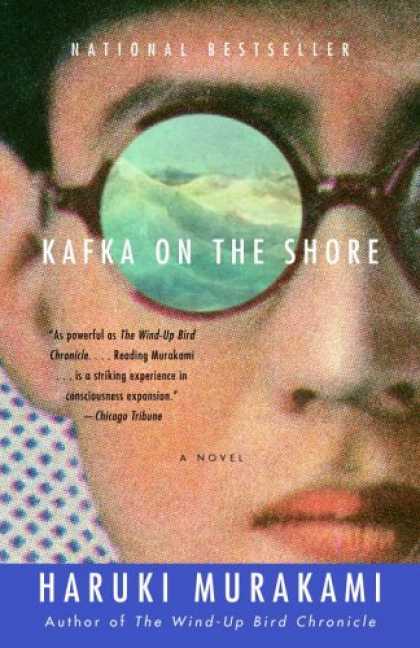
Kafka on the Shore - Haruki Murakami

I finished reading Kafka on the Shore over a week ago now, but I couldn't begin to write a review on it because I needed more time to think about it.  Now, after waiting more time I find myself in the same predicament.  I feel like I would have to read this book at least five more times before I could write a review that would do it justice.  This is by far one of my favorite books, and I guarantee I will be reading more Murakami in the future.  It is written in a style that exudes beauty, simplicity, purity, and innocence.  As I read Kafka on the Shore I often began to feel like the world was simpler, purer, and more welcoming.  I can only describe it as being able to once again look at the world like you did before your innocence was lost.  That's not to say that the entire book is lacking any darkness.  In fact, there is quite a bit of violence, sexuality, and other mature themes throughout the entire story, but I never once felt that they were vulgar or gratuitous.  They were simply there because evil is a part of life, and innocence and purity cannot avoid them forever.

Kafka on the Shore is a story about two characters.  The first is a young fifteen year old boy named Kafka Tamura, who has run away from his home in Tokyo.  He is on a journey to find his mother and older sister who left when he was just a small boy.  His journey brings him to a library in the town of Takamatsu where he becomes involved in the lives of the library's owner Ms. Saeki and worker Oshima.  The second character is an old man named Nakata, who has the ability to communicate with cats.  He becomes involved in a mystery to find a specific cat, and soon finds himself traveling across Japan as the mystery unfolds.  Kafka and Nakata's paths are deeply intertwined, but not necessarily in the physical realm.  The story frequently merges into the metaphysical, and often leaves questions unanswered, forcing the reader to draw their own conclusions.  For this reader at least, that was one of the more endearing factors of the book.

"Kafka on the Shore" is the type of book that you really have to read in order to understand the experience.  Just writing this review alone was a study in frustration, pushing my descriptive skills to the next level.  Trying to summarize it is like trying to explain a beautiful sunset, or an amazing experience in your life.  Sometimes you experience something that hits you right between the eyes, gripping you in a way that was completely new and unexpected.  You try to tell someone about the experience, but you just know that no words in the English language are going to get the message across exactly like you experienced it.  Maybe that's why this book was originally written in Japanese?  All joking aside, if you are willing to let your imagination soar, keep an open mind to deeper meanings, and be satisfied with not having all loose ends tied up, there is a fantastic journey waiting to be had in "Kafka on the Shore."  After all, isn't the journey of imagination what reading is really all about?

Thursday, March 10, 2011

House of Leaves - Mark Z. Danielewski

If you've been reading my blog for at least a couple weeks you know that I've been reading a novel that has been busting my brain.  Well, that novel has finally reached it's last page, and now I take on the difficult task of reviewing it.  House of Leaves reminds me a lot of dating a few of my ex-girlfriends (actually, maybe all of them).  When I first picked up the book I loved the cover, and I found the concept interesting and appealing.  The short description seemed like just what I was looking for.  But then I started reading, and I realized things just weren't going to work out like I had hoped.  Like my ex's, House of Leaves wasn't exactly a bad book, in fact it had many great qualities that will probably appeal to future readers.  (See how I put that last sentence in there just in case any of my ex's read this?)  At the same time, sometimes a book (or woman) has such a great cover and concept that you keep trying to convince yourself that you actually like it more than you do.  You keep reading, and keep reading, getting more and more frustrated until finally you realize that no matter how hard you try, this book will never be one that meshes with you.  Is it just me or was that analogy awesome?

House of Leaves starts out from the perspective of tattoo artist Johnny Truant.  Through a short chain of events Truant comes into possession of a trunk that formerly belonged to a man named Zampano.  In the trunk is a manuscript written by Zampano about a documentary film called "The Navidson Record".  The Navidson Record is a short film about Will Navidson, his wife Karen, and their children.  Several other characters come into play as the film progresses.  It documents their experiences living in a home in Virginia, and the mysterious anomalies that take place in the house.  Will first notices something strange about the house when he realizes that the dimensions of the master bedroom have changed.  He begins to measure, and discovers that the inner dimensions of the room are larger than the outer dimensions.  During this investigation the house produces two new mysteries, the first being a new hallway between rooms, and the second being a doorway that previously was not there.  The doorway is of particular interest because when opened it reveals a long hallway of around 30 feet that extends beyond the outer dimensions of the house.  This hallway also contains other doors that lead to new hallways and corridors that far extend beyond the dimensions of the house.  Navidson's film then becomes a record of several explorations into the labyrinth of these halls and the horrors found within.  That word "horror" is extremely appropriate.  House of Leaves alternates between Truant's narrative, Zampano's account of the Navidson Record, and many other interjected commentaries from other written perspectives on the film.

I am really torn on this book.  The actual story line is great, and thoroughly enjoyable.  It's just that there is so much "other stuff" that just ruined it for me.  It is written in a crazy style where Danielewski switches perspectives mid-sentence, makes you read a multitude of footnotes, puts text upside down, and does  about a million other things that all drive this reader crazy.  There are also long periods where the story just stops and you are forced to read forty pages of word studies, commentaries written by people that don't even exist, or pages with the entire text crossed out.  I'm sure that there was a reason for all this, but I always felt like there was some hidden secret that I wasn't privy to.  It's not exactly fun to read a book feeling like you are always missing something.  At the same time, as I already said, the story itself was awesome so I kept reading through all the stuff I hated just in order to once again engage in the great parts.  If you are willing to put up with a lot of craziness and possible frustration, there is a great story hidden within House of Leaves, you just might have to dig a little harder than you would like in order to find it.

Monday, March 7, 2011

Batman: The Dark Knight Returns - Frank Miller

There is something a little nerve wrecking about picking up a book about a character you love.  You come into the experience with certain expectations, and you don't know whether they will be met or not.  It's sort of like when U2 releases a new album and I always walk to the check out counter thinking, "Please God don't let this be the album where it all goes to crap."  Maybe U2 was a bad example since people might argue that happened a long time ago, but I think you know what I mean.  Batman has always been a character that I love.  From the reruns of the classic TV show with Adam West, the action figures, the animated series, the footy pajamas, and now the excellent Dark Knight movies, Batman has been a part of my entire life.  Sure things got a little bit scary when the neon lights flooded Gotham City, but we can always lock those movies away with the newest Star Wars trilogy right?  It was with this feeling of unease that I peeled back the cover of Frank Miller's graphic novel, and was soon reassured that everything was as it should be in Gotham City.

The Dark Knight Returns takes place ten years after the voluntary retirement of Bruce Wayne as Batman.  Most superheroes (excluding Superman) have been forced into retirement due to a distrusting public and government.  Bruce Wayne is haunted by the death of the second Robin (Jason Todd) as well as the death of his parents.  He is becoming more and more disillusioned with the current state of Gotham City, the new government, the rising crime and corruption, and the general sense of fear among its citizens.  After Harvey Dent (aka "Two-Face") is released as "rehabilitated", a crime spree starts and Bruce is once again forced to don the cape and cowl to return as the caped crusader.  Unfortunately Gotham City's welcome is mixed, and Batman soon finds himself fighting old and new enemies, as well as a few former allies. 

 Frank Miller's story is everything that a Batman comic should be.  It's dark, gritty, political, and full of action and intrigue.  Miller does an excellent job of making the story his own, while still keeping enough of the established lore intact.  Where he does take chances I found myself loving the directions he took and never disagreeing with the gambles.  The only negative for me was that with each turned page I knew that I was drawing a bit closer to the end of the Batman saga.  It was like watching an old friend slowly get older, more feeble, and knowing that the end would come before you were ready.  When you have lived with Batman for as long as I have, I'm not sure you are ever ready for him to put the cape and cowl away, but who knows, maybe in another ten years Gotham City might just need him again.

Sunday, March 6, 2011

Fables - Bill Willingham

When I first heard about Fables I was immediately drawn to the concept.  The characters from folklore and fairy tales have been kicked out of their respective kingdom by a villain named "The Adversary", and have been forced to enter our human world.  The characters that are able to take human form are allowed to live in the middle of New York City in a large building called Fabletown, while the other non-human characters are forced to live outside the city at "The Farm".  Characters like Snow White, Beauty and the Beast, Jack (down from the beanstalk), and even "Bigby" the big bad wolf (now able to take human form) all reside in the middle of New York, while the three little pigs, Brier Rabbit, and others must all stay hidden away in the country.  This separation causes problems between the two groups, as many of the farm fables feel segregated and left to rot away from outside contact.  Problems also arise in the city as Rose Red, sister of Snow White, is missing and presumed murdered.  Bigby the big bad wolf is on the murder case, and looking for answers.

The first hardcover edition of Fables covers two separate story lines.  The first is the story of Rose Red's murder, and Bigby's investigation.  While the plot was well written and interesting, I never really felt like I was reading about folklore characters.  Sure they were named Snow White, Jack, and The Big Bad Wolf, but they all looked human, acted human, and could have easily been humans for all I knew.  There were brief moments of fantasy, but they ended too soon and left me saying, "That's it??"  I enjoyed the story, but really wanted the fables to come alive more than they did.  Thankfully, there was a second story line that didn't disappoint.  This second story explores the mutiny at The Farm, and the ensuing conflict between city fables and country fables.  Here we get the full effect of what got me excited about the series in the first place.  Talking pigs, Red Riding Hood packing heat, the tortoise and the hare toting machine guns, and sleeping giants that awaken from hundred year slumbers.  You know...the good stuff!  Even though it takes a while for Fables to grasp it's true identity, once it does it is a great adventure that really delivers.

Even though Fables is focused on children's characters, this is definitely not a book for little kids.  There are several adult themes, some inappropriate language, and occasional violent images.  These themes are more obvious in the first story arc, and seem to simmer down as the second arc starts.  Seeing as this is a comic I also should mention the artwork.  Unfortunately of all the comics I have read lately, the artwork in Fables was among my least favorite.  The cover art is absolutely beautiful, but unfortunately it doesn't carry over to the inside.  Despite my personal taste I don't feel like it distracted or took away from an otherwise well done series.  If you enjoyed nursery rhymes and folk lore as a kid, then you might also enjoy the way they have matured and grown into adulthood with you.

Saturday, March 5, 2011

The Sixth Gun - Cullen Bunn & Brian Hurtt

Let's see, how many blog posts can I start by referencing my buddy Jeff?  I should really link his website one of these days...maybe tomorrow.  Anyways, once again I am reading a book that comes highly recommended by Mr. Jeff Wester.  In case you are wondering, yes, I do occasionally find books on my own, but this isn't one of those times.  Fortunately for me Jeff has yet to steer me wrong, (although the verdict is still out on a certain book that will not be named) and The Sixth Gun is no exception.

The story takes place in the years following the Civil War and follows Drake Sinclair, a man with few morals, a love for money, and a knack for getting in and out of tough situations.  During the Civil War a band of evil confederate men find themselves in possession of six pistols that hold great power.  The most powerful of them, the sixth gun, belongs to their leader General Oleander Hume.  While each gun contains a unique power, they can only be wielded by their owner, and ownership can only be transferred upon death.  At the start of the story, General Hume has been defeated and locked away in a prison far from the reaches of the sun's light.  His gun has been taken, and through a course of events become linked to a young woman named Becky Montcrief.  General Hume is soon liberated by his gang, and the six villains head off to reclaim the lost sixth gun.  Of course Becky and Drake soon become entangled in the adventure, teaming up to protect the gun and maybe even claim a few of the others in the process.

The Sixth Gun is one of those stories that really hits the ground running.  This is a story about action and adventure, and it has plenty of both.  It is a fun read that doesn't take itself too seriously, and keeps the entertainment coming.  Sometimes you just want to sit down and be entertained for a while without having to think about deep social issues, or whatever other stuff that authors like to interject into their books.  The Sixth Gun was the perfect blend of fun, adventure, and pure enjoyment for me.  That's not to say that it lacks substance, but simply that it doesn't try too hard to be something it's not.  The art style also fits perfectly with the storytelling.  It is a simple style, very cartoony, and yet full of simple details that made my eyes stray back to previous panels to look again.  Overall it is a very promising new series that has a lot of potential.  If you are looking for a new series to get you started in the comic world, then Jeff highly...I mean, I highly recommend it!

Tuesday, February 8, 2011

George Müller: Delighted in God - Roger Steer

I love to read biographies.  There is something extremely exciting and inspiring about a person who rises above the generally accepted mediocrity of human life to do something exceptional.  It can also be very exciting to see (or read about) someone who lived as an example of principles we value.  We find comfort in the realization that the goals and beliefs we hold dear, and may or may not have obtained in our own lives, have come to fruition somewhere else.  We can look at their life and say, "Wow, now there's someone who really did it!" Maybe we take comfort in knowing that it is possible despite our own failings.  Maybe we are inspired to push ourselves to new levels because of their story.  Whatever the reasoning, I continue to love a good biography.

George Müller was a German man who lived during the 19th century.  He started out as a bit of a lost cause, but ended up as one of the most well known examples of the power of prayer and complete surrender to God's will.  As a young man, Müller was constantly in trouble.  Chased by the law and his debtors, he was on a self destructive path.  One day he was invited to a Bible study where he heard the word of God, and was so convicted that he decided to accept Christ on the spot.  From that day he was a changed man.  He felt called to become a pastor, and soon found himself leading a church.  As the church grew he began to have a passion for the abandoned children of England.  Many kids were orphaned when their parents died, or simply left to fend for themselves on the streets or in the work houses.  Müller felt God calling him to minister to these outcast children, and so he started to pray that God would allow him to open an orphanage.  For over 60 years Müller worked with orphaned children, opening multiple orphanages and ministering to thousands.  The miracle of his life is that he never once asked anyone for money, never did any fund raising, and never relied on anyone besides God to see him through.  He would simply pray earnestly that God would meet their needs, and through prayer his ministry flourished! 

George Müller's story is one that took me a little bit by surprise.  In one sense it is the story of a great man who's accomplishments far exceed most other humans.  Looking back on his life no one could argue that he failed to accomplish much.  On the other hand, it is a story about an average Joe, someone who's own merits and actions do not impress or go outside of the scope of what we would consider normal human behavior.  In fact, Müller is most well known for praying, something that the majority of people attest to doing in their own lives.  Müller's biography is less about Müller, and more about the power behind our prayers.  It is a testament to how God honors the prayers of his children, and opens doors for those who are faithful.  George Müller was faithful in the small things, and because of that God opened huge doors and allowed him to impact thousands upon thousands of young men and women.  Although his humanitarian accomplishments are great, the lasting impact of Müller's life is that his testimony continues to proclaim that God can do immeasurably more than we ask or imagine, as long as we are willing to honor Him.

Wednesday, January 5, 2011

The Raw Shark Texts - Steven Hall

Imagine waking up one morning, and finding yourself laying in the middle of the floor looking up at the ceiling.  The problem is, you don't recognize the house you're in, or remember how you got there.  In fact, you can't remember anything at all.  Your name, age, occupation, address, family, and past are all a complete mystery.  In "The Raw Shark Texts" the protagonist finds himself in this exact situation, but with one major twist.  He has been left a single clue with which to unravel the mystery of his past: a written note left by a man named Eric Sanderson, also known as...himself.  This single letter is soon followed up by a visit to a former doctor who has insight into Eric's situation.  With the doctor's help Eric's life moves back into a a sense of normalcy and routine, that is until more letters from himself begin to arrive daily in the mail.  He soon discovers that his "normal" life is not at all what it seems, and he embarks on a journey to discover the truth of his past, no matter what dangers await.

The problem with reviewing a book like this is that you really can't say a whole lot about it, because too much information would totally ruin it for a first-time reader.  It reminds me of putting a puzzle together without knowing what the final picture is suppose to look like.  If someone walked into the room and said, "Oh yeah I've built this one before...it's the Empire State Building!", then it would completely ruin the moment of realization for the builder.  The same is true of "The Raw Shark Texts".  As each piece of Eric's past is revealed, the reader finds themselves one step closer to the final picture, but still just barely unable to realize what it looks like.  At the same time, Hall does an excellent job of making the reader believe they are building the Empire State Building, but when the moment of realization comes you discover you have been building a picture of an eight legged dog wearing a mini skirt and dancing on the rings of Saturn.  In other words, he will completely mess with your sense of reality and keep you guessing till the end. 

"The Raw Shark Texts" is one of those rare books that just seem to hit the mark on every level.  It is one part sci-fi, one part mystery, and 100% mind trip.  It doesn't take itself too seriously, but instead stays fun and edgy the entire time.  It will challenge your perceptions of reality, but in a fun and exciting way that makes you want to keep reading just one more page...all the way until there are no more pages to flip.  At the same time, you might just find yourself flipping back to page one to keep the experience going.

Saturday, November 20, 2010

Scott Pilgrim - Bryan Lee O'Malley

It's sort of sad (or maybe awesome?) that in the short span of a month, my blog has digressed from writings about great theological minds and works...to comic books.  While I am not an avid comic reader, I recently became a huge fan of this well known series of six graphic novels about my main man Scott Pilgrim.  Some of you may be familiar with the movie that came out earlier this year entitled "Scott Pilgrim vs. the World", which starred Michael Cera.  I saw the movie a mere week ago, and have ever since been on a quest to find and absorb all things with "Scott Pilgrim" in the title (yes even the video game!).  Anyways, enough about me and my seemingly age-inappropriate obsession...lets talk about these books!

Scott Pilgrim is a 23 year old video game junkie that lives in Toronto with his gay roommate Wallace, plays bass in the band "Sex Bob-Omb", and has a huge crush on an American delivery girl named Ramona Flowers.  In order to date Ramona he must first battle and defeat her seven evil ex-boyfriends.  The storyline consists of everyday life and the drama of dating, mixed in with epic battles and over the top fight scenes.  O'Malley is a master of youth culture, and really captures the look and feel of young adulthood.  The characters are typical young 20 somethings; they play video games, party, go to shows, thrive on drama, and shop at Goodwill.  You can't help but love each and every character, because they are so unique and their stories are lovable and familiar.

While the series is in comic format, it is definitely not for everyone.  There are some swear words, sexual moments, and mature themes sprinkled into the story, but none of them are overdone or over the top.  At the same time it is extremely easy to overlook the negatives due to the overwhelming awesomeness of these books.  Anyone who knows rock music, video games, or indie culture will find multiple references and inside jokes on every page.  I was caught laughing out loud on many occasions.  The art style is also very well done, and I often found myself going back to look at the drawings a second or third time.  The appeal of the Scott Pilgrim books is somewhat hard to explain.  They appeal to the inner nerd/rock star/youth culture enthusiasts in a way that other forms of media cannot.  Trying to explain it is like trying to explain why kids love Cinnamon Toast Crunch.  Scott Pilgrim doesn't need to be explained, he's just awesome.

Friday, November 19, 2010

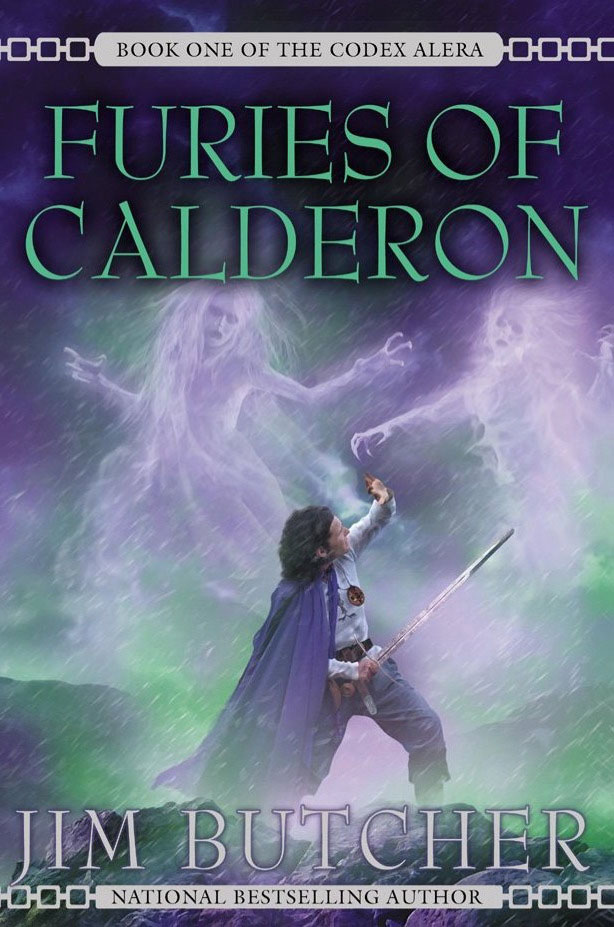
Furies of Calderon - Jim Butcher

"Furies of Calderon" is the first novel in a series of six books titled "The Codex Alera", written by Jim Butcher.  Butcher is most well known for his series, "The Dresden Files", which are about a wizard who works in modern day Chicago as a private investigator.  Already an established writer, Butcher started "The Codex Alera" series based on a bet he made with another writer at a writer's convention.  The bet was that Butcher could not write a good story based on a terrible concept.  Butcher countered that he would allow the other writer to pick TWO bad concepts, and then write a great work based on them.  The other writer chose the concepts of the lost 9th Roman Legion, and Pokemon!  Butcher then went on to write "The Codex Alera" which has become his second highly acclaimed series, and further cemented him as one of today's leading fantasy authors.

The series takes place in the world of Carna, or more specifically in the realm of Alera, which is an empire very similar to Rome.  In this empire, the citizens are able to bond with elemental spirits, known as "furies", and are able to use those spirits to perform beyond their human abilities.  Spirits of fire, water, wind, earth, wood, and metal can all be bonded with, and each grants unique characteristics.  In this world we find the story of a young man named Tavi, who is unable to bond with any element.  He is considered a freak to his people, and a social outcast.  Tavi becomes aware of a sinister plot to overthrow the government, and possible destroy everything he knows and loves.  Having no power and no social standing, he must defy the odds and try to save the kingdom before it is utterly destroyed.  

While I doubt that "The Codex Alera" will ever stand up to the true masterpieces of fantasy literature, I still recommend it.  It is well written, and Butcher does a great job of drawing the reader into the lives of his characters.  Each character's story is interesting, and wants to be fully explored.  While Butcher's "Dresden Files" series is much more adult in content, "The Codex Alera" does a great job of appealing to all audiences.  There are a few swear words and romantic scenes, but Butcher does a good job of keeping them PG rated and avoiding the details like many other authors seem unable to do. The story is complex enough for adults, but it is written in a way that even younger readers could enjoy.  If you are looking for a well written fantasy series that delivers an interesting story, intense action, and a little bit of romance, then this is a great series to put on your reading list.

Wednesday, November 3, 2010

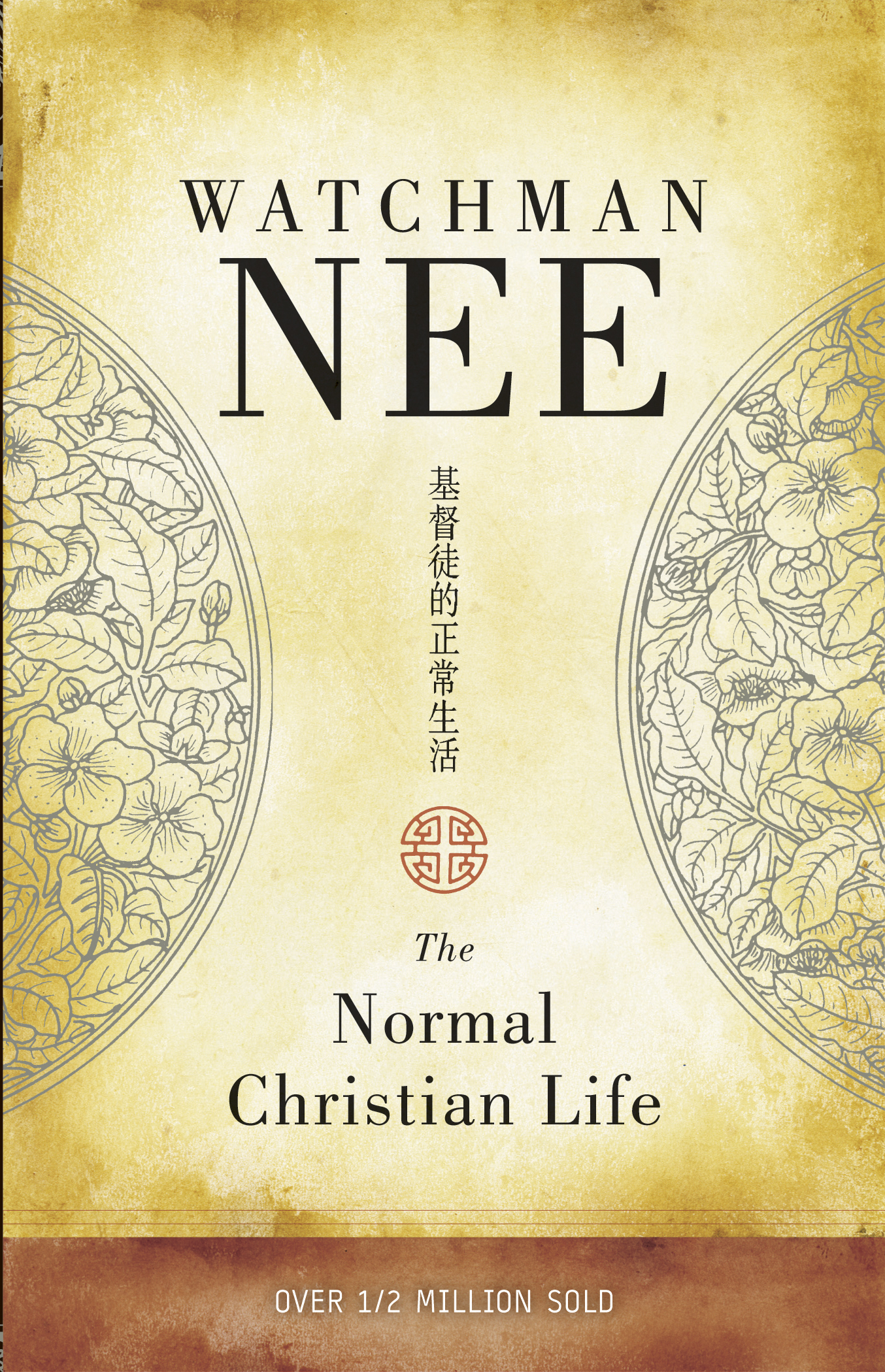
The Normal Christian Life - Watchman Nee

"The Normal Christian Life" is a masterful blend of simple truth and complex analysis.  Nee avoids the "meaningless arguments" that often times become the focus of theological discussion, and instead goes straight to the core of Christianity.  Man is sinful.  God is without sin.  Jesus' death on the cross atoned for our sin.  We accept this, and Christ comes to live in us.  Today we often refer to these truths as "The Romans Road".  These are the truths of real importance, to which all other truths must eventually compare.  To the average Christian the truths found in the "Romans Road" are not exactly new revelation, and yet Nee is able to take the overly familiar and make it fresh, or as he says, "...to make things simple, and to explain clearly some of the experiences which Christians commonly pass through." 

Nee takes the reader down a trail of thought that he refers to as "The Path of Progress".  This path consists of knowing, reckoning, presenting ourselves to God, and walking in the Spirit.  We "know" many truths of Christianity.  For example, Christ died for my sins.  However, until we "reckon" (or "take into account") that knowledge, then it is really useless in my life.  God requires us to act on what we know.  Unfortunately, being human we are completely unable to act on our knowledge of God's will, because any action we attempt is futile and will eventually fail.  We are sinful.  We can do nothing good apart from God.  Therefore, the next step is to present ourselves to God, and to allow Him to change us.  Nee is quick to point out that this step does not simply mean "accepting Christ".  It is also the declaration that my entire life belongs to Christ, and reckoning that statement as true.  The final step is to walk in the Spirit, or trusting the Holy Spirit to do in me what I cannot do myself.  This is not a human effort to live out a God given standard.  Instead it is the acceptance that we need God to live His holy standard in us.  Therefore we become free from the sin and condemnation that comes from our humanity. 

As I read this book I was constantly struggling with what I read.  Not because I disagreed with what I was reading, but because my mind was resisting the move from belief to reckoning.  If you are a Christian reading this book, you will find it hard to disagree with the knowledge he presents.  However, if you are like me you may find it extremely challenging to accept the changes he suggests based on that knowledge.  The difficulty is not to accept new truths, but to view those truths from a new angle and to act based on that fresh viewpoint.  Because of the range of biblical truths covered and the action required for each one, this is not a book you simply read once and put on the shelf.  It would be difficult to absorb and acclimate our lives to everything Nee is proposing in just one reading.  This is a book that one should take off the shelf again and again, gleaning new understanding and acceptance of the truths of Christ, and allowing those truths to change you.  With each reading you just might come away with your "normal Christian life" looking a little different than it did before.

Wednesday, October 27, 2010

Bonhoeffer - Eric Metaxas

Every once in a while I like to walk into my local Christian book store and just poke around.  I usually compare the process to the equivalent of clothing shopping at Ross.  You usually have to stop by five or six times before you find a shirt you like that also happens to be in your size.  On one such trip I decided to inquire of my favorite lady behind the counter (Pam, she rocks), asking "Any 'must reads' come out lately?"  Without blinking she reached behind the counter, and brought out the book "Bonhoeffer".  My immediate reaction was, "What's a Bonhoeffer??"  Pam's answer?  "Trust me...just read it."  So after paying her, I took my newly purchased book of which I knew absolutely nothing, and proceeded to my local coffee house (shameless plug for Rogue Coffee Roasters on G Street...check it out!).

From the moment I read the first line of this book I was captivated.  I have been a long-time fan of biographies, and Metaxas' work only succeeded at further solidifying my opinion.  I would rank it as undoubtedly my new favorite in the genre.  As I soon discovered, Dietrich Bonhoeffer was a key leader in the Confessing Church during Nazi era Germany.  The Confessing Church was formed in direct opposition to the "German Church" the Third Reich formed and supported and which preached a perverted version of Christianity.  Bonhoeffer continuously put his life in danger as he spoke out against the Nazi party and Hitler, fought the teachings of the German Church, and even reported  to Allied leaders in England as a spy.  He also founded and taught at an illegal seminary in Nazi Germany,  training many young men who would later contribute to the work of the Confessing Church, and in some cases to the fight against Hitler.  Bonhoeffer himself also became a very important part of several conspiracies to kill Hitler, although none were successful.  The most notable of these conspiracies was the Valkyrie plot that was recently made into a movie.  Bonhoeffer's greatest legacy was his writings on theology that are highly acclaimed to this day.  The most famous of these was his life work entitled "Ethics".  Although he was eventually martyred for his work, his legacy continues on through his writings, many of which have been preserved through colleagues, family, and friends.  These writings make up a very significant portion of the book.

The book is a fantastic mix of life story, Germany history, and sound Biblical theology.  The three work together quite well.  The theology of Bonhoeffer is frequently a bit complicated and sometimes required a few readings to fully comprehend, but overall you cannot help but be drawn in to his paths of thought about Christ and the discipline of living out your faith in a very real and faithless world.  The book does an expert job of surrounding Bonhoeffer's theological thoughts and writings with a very detailed account of his life, and how the daily challenges he faced directly contributed to his theology.  The realities of life in Nazi Germany forced Bonhoeffer to make tough decisions concerning Christian responsibility in the face of evil.  Is it wrong to oppose a human government that God has established even when they are instigating unfathomable evils?  Is is a sin to kill a man responsible for genocide?  Does God always desire His followers to "turn the other cheek" no matter the injustice?  For Bonhoeffer theology was not simply knowledge, it was real life.  He did not write for the sake of writing, instead he documented the real moral dilemmas he himself faced on a daily basis, comparing those thoughts to the thoughts of His creator and the writings of scripture.  His theology comes to life as we read it through the lens of his life experience.